 |
||||
 |
||||
 |
||||
 |
|
 |
||
 |
|
|||
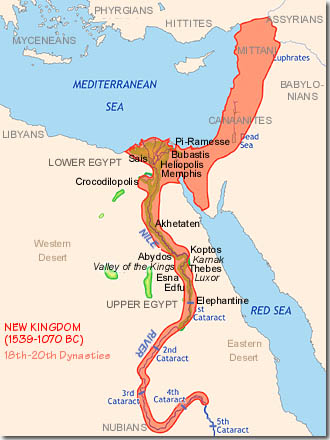
| Internally, the local nome governors that had opposed both the Hyksos and the 17th Dynasty were brought to heel. Those that survived became royal administrators and their lands passed to the throne. Centralized administration of the Nile Valley resumed. Agricultural production soared. The spoils from the many successful military campaigns and the tributes paid by the conquered states increased Egypt’s prosperity even more. The unprecedented wealth was transferred into a tremendous building boom unseen since the Old Kingdom: new temples were built, and older ones restored or enlarged. Architecture reached a new zenith with enormous construction at Karnak near Thebes. Amun By the time of Amenhotep III (1382-1344 BC), Egypt had become so rich that the pharaoh felt no need to expand the borders. He maintained the empire, collected tribute, and bought off potential threats. Amenhotep III was succeeded by his son Amenhotep IV (1350-1334 BC). Thus began the famous "Amarna Period". Amenhotep IV, driven by zeal for his new religion - a monotheistic cult built around Aten, the Sun Disk - changed his name to Akhenaton and moved the capital from Thebes to totally new city he built from the ground up and named Akhetaten. Here with his beautiful wife Nefertiti, he concentrated on developing his religion and ignored the world outside of Egypt. He introduced a new, naturalistic art that was a complete turnabout from the stylized friezes that had dominated Egyptian art for 1700 years. The new religion was something that had never happened before in Egypt. Previously, new gods came along and were absorbed into the culture, but no god was allowed to push out any old ones. Akhenaton, however, formed a monotheistic religion around Aten and banned the worship of all other gods. This forced the old gods (especially the great god of Thebes, Amun) and their priests underground. They formed a fierce and disgruntled opposition to Akhenaton and his new world. Akenaton apparently had peculiar physical features. Traditional Egyptian art portrayed pharaohs in a highly stylized manner. Akenhaten however, was shown in paintings and carvings with wide hips, pendulous belly and breasts and an elongated face and skull. Some theories assume that the depiction is accurate and not stylized, suggesting that Akenhaton suffered from birth defects which were common among the incestuous Egyptian royal families. How this related to his revolutionary theology is unknown. Towards the end of his 17-year reign Akenaton took as co-regent Smenkhkare (1336-1334 BC), who was possibly his brother. Their co-reign lasted only two years. When Akhenaton died, worship of the old gods revived with a vengeance. In truth, it had never ended and their priests quickly resumed their positions of power. Smenkhkare died soon after and in his place was crowned a boy, Tutankhaton (1334-1325 BC) - possibly another of Akenaton's brothers. He was unready to rule the then turbulent empire. Powerful advisors - the most influential being the vizier Ay and the warlord Horemheb - made the decisions. With the resurgence of Amun Tutankhaton was re-named Tutankhamun. Tutankhamun died while he was still a teenager and was succeeded by Ay (1325-1321 BC) , who probably married Tutankhamun's widow to strengthen his claim to the throne. It is possible that Horemheb made Ay a monarch to act as a transitional king until he was ready to take over. In any case, when Ay died, Horemheb (1323-1295 BC) became pharaoh and a new period of powerful rule began. Horemheb set about to restore internal stability and tradition, and re-establish the international prestige Egypt had before Akhenaton. After Horemheb another general - Ramesses I (1295-1294 BC) - founded the 19th Dynasty. He only reigned for a short time and was followed by Seti I (1294-1279 BC). Seti I carried on the work of Horemheb in rebuilding the administration and the power and respect of Egypt abroad. He also resumed the formidable building program of the 18th Dynasty and built the magnificent temple at Abydos. Seti's son was Ramesses II "the Great" (1279-1213 BC). His long reign formed one of the last and greastest of ancient Egypt's golden ages. Ramesses II carried on his father's work and created numerous splendid temples, including the spectacular Colossus at Abu Simbel. He fought to regain the lost territories abroad and re-conquered large areas of the Near East. But the international situation had changed, and the Egyptians found themselves facing a new and powerful enemy: the Hittites. The enmity between Egypt and the Hittites finally came to an end in the 21st year of Ramesses II’s rule with a peace treaty between the two countries. The remainder of the long reign of Ramesses II would be peaceful and prosperous. He ruled for 66 years and fathered numerous sons, whose tombs fill the necropolis at the Valley of the Kings. The reign of Rameses II is often given as the most likely date for the Exodus of the Israelites from Egypt. There are no records in Egyptian history of any of the events described in the Bible, however, nor any archaeological evidence. (Seti I and Ramesses II, however, were the only two pharaohs known to have been circumcised.) Ramesses II was succeeded by his son Merenptah (1213-1203 BC). But Ramesses II’s successors were unable to follow in his footsteps. The 19th Dynasty withered away in dynastic disputes and incompetence. There were five pharaohs in 20 years. With the 20th Dynasty, Egypt’s 500-year period of unprecedented prosperity and relative stability slowly came to an end. Ramesses III (1184-1153 BC) was clearly a very capable ruler. He successfully repelled several foreign invasions and restored Egyptian power in Canaan and Syria. But his 30-year reign was also marked by corruption, social turmoil and conspiracies. In the years following his death, Egypt’s unity and stability began falling apart. The Theban priesthood of Amun became more and more the de facto rulers of Upper Egypt. Royal administrators in Lower Egypt wielded power in the name of the figurehead pharaohs (all called Ramesses). The army grew insolent, especially troops descended from former Libyan prisoners of war. They too claimed a place in the government and slices of territory. With the death of Ramesses XI (1099-1069 BC), Egypt splintered into factions. The 20th Dynasty and the long, glorious New Kingdom came to an end.
|
||||