FREDERICK III
of Germany
1831 to 1888
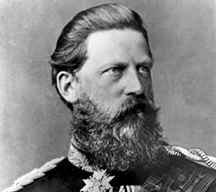 Frederick III was the king of Prussia and emperor of Germany from March 9 to June 15, 1888, and the son of Emperor William I. Frederick was born in Potsdam, Germany. When his father succeeded to the throne of Prussia in 1861, Frederick became Frederick William, crown prince of Prussia. Liberal in his political views, Frederick opposed the conservative policies of the German chancellor, Prince Otto von Bismarck. Although Frederick opposed war, he became commander of an army and led Prussian forces to victory over the Austrians at the Battle of Sadová (also known as Sadowa) in 1866, which terminated the Seven Weeks' War. During the Franco-Prussian War of 1870 and 1871, Frederick commanded the armies of the southern German states, participating in the Battle of Sedan and the siege of Paris, France.
A man of learning and culture, Frederick patronized art and literature and encouraged the work of the royal museums. His wife was Victoria, Princess Royal of England, daughter of Queen Victoria. He was sympathetic to the English, and was quite popular there.
As Crown Prince Frederick William, he was genially called "Our Fritz" by the German people, most of whom anticipated with pleasure his accession to the throne.
Frederick became ill, however, in 1887 and lived only three months after succeeding to the throne on his father's death in 1888. He was in turn succeeded by his son, William II.
William II was egotistical and jingoistic, and his policies led in no small part to the outbreak of the First World War, which set the pattern for the violence, warfare, and holocaust in the 20th century. It is interesting to speculate what might have happened if his liberal, enlightened father had led Germany into the new century.