CLEISTHENES
of Athens
570 to ? B.C.
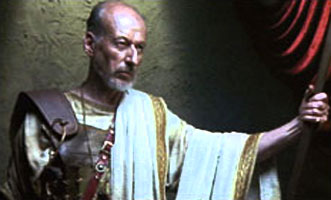 Cleisthenes (Greek: Κλεισθένης, also Clisthenes or Kleisthenes) was a noble Athenian of the Alcmaeonid family. He is credited with reforming the constitution of ancient Athens and setting it on a democratic footing in 508 BC or 507 BC. For these accomplishments, historians refer to him as "the father of Athenian democracy." He was the maternal grandson of the tyrant Cleisthenes of Sicyon, as the younger son of the latter's daughter Agariste and her husband Megacles.
Cleisthenes was credited for increasing the power of the assembly and breaking up the power of the Athenian nobility.
With help from his own clan the Alcmaeonidae, Cleisthenes was responsible for overthrowing Hippias, the tyrant of Athens. After the collapse of Hippias' tyranny, Isagoras and Cleisthenes were rivals for power, but Isagoras won the upper hand by appealing to the Spartan king Cleomenes I to help him expel Cleisthenes.
Consequently, Cleisthenes left Athens as an exile, and Isagoras was unrivaled in power within the city. Isagoras set about uprooting hundreds of political opponents from their homes, including the entire Alcmaeonid clan, whom he labeled as "Accursed". He also attempted to dissolve the council of elders of the city.
But the council resisted, and the Athenian people declared their support of it. Hence Isagoras and his supporters were forced to flee to the Acropolis, remaining besieged there for two days. On the third, they fled and were banished. Cleisthenes was subsequently recalled, along with hundreds of exiles, and he assumed leadership of Athens.
After this victory (508–507 BC) Cleisthenes began to reform the government of Athens. In order to forestall strife between the traditional clans, which had led to the tyranny in the first place, he changed the political organization from the four original tribes, which were based on family relations, into ten tribes according to their area of residence.
He also established legislative bodies run by individuals chosen by lottery (a true test of real democracy), rather than kinship or heredity. He reorganized the Boule, the Athenian "city council". The court system was also reorganized with new jurors selected each day. It was the role of the Boule to propose laws to the assembly of voters, who convened in Athens around forty times a year for this purpose. The bills proposed could be rejected, passed or returned for amendments by the assembly.
Cleisthenes also may have introduced ostracism (first used in 487 BC), whereby a vote from more than 6,000 of the citizens would exile a citizen for 10 years. The initial idea was to restrain a citizen deemed a threat to the democracy (for having ambitions to set himself up as tyrant, for example). However, soon after, any citizen judged to have too much power in the city tended to be targeted for exile (e.g. Xanthippus in 485/84 BC). Under this system, the exiled man's property was maintained, but he was not physically allowed in the city and so potentially create a new tyranny.
Cleisthenes called these reforms isonomia, meaning "equality before the law" (iso, "equality"; nomos, "law") The word demokratia - "rule by the people" was applied after his time.
Soon after Cleisthenes' reforms his life becomes a mystery, as no ancient texts mention him thereafter. It is possible that Cleisthenes himself suffered ostracism, for seeking support from the Persians against the Spartans.
Cleisthenes' ideas revolutionized Greek political thought of the time. But even Cleisthenes could not bring full change to Athens, and old institutions of the rich aristocrats still existed. However, most scholars would argue that all modern day western democratic politics are based on his work.