 |
||||||||
 |
||||||||
 |
||||||||
 |
|
 |
||||||
 |
|
|||||||
|
 |
|||||||
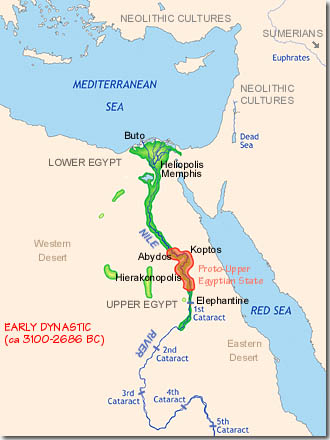
In Lower Egypt, a more commercial system ran the state. The centers of wealth were ruled over by important families or groups in each town, rather than by a single hierarchy. Ma'adi, Buto and Tell Farkha were the larger towns of the state, with the capital probably at Buto. The rulers of Lower Egypt wore the red crown. Not much is known about these rulers, other than their names. Some believe that there was never one ruler over Lower Egypt in Predynastic times, because of a lack of evidence of these rulers. By the beginning of the Early Dynastic period, 90% of Buto's pottery was from Upper Egypt, and so the Delta region had apparently been economically penetrated by the Upper Egyptians at that time.
|
 |
|||||||
FIRST
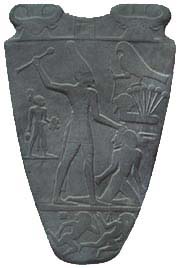
PHARAOH The famous Narmer palette (right) shows him on one side wearing the white crown of Upper Egypt and the other shows him wearing the red crown of Lower Egypt. It also shows the hawk emblem of Horus, the Upper Egyptian god of Hierakonpolis, dominating Lower Egypt personified by a papyrus marsh. From this, Narmer is believed to have unified Egypt. Manetho attributes the unification of Egypt to Aha "Fighter" Menes. He has been listed as the first pharaoh of the 1st Dynasty, but Menes and Narmer may be one and the same man. Menes was from Thinis, in the south of Upper Egypt, but he built his capital at Memphis. The Narmer palette was found in the temple at Hierakonpolis where they had been dedicated to Horus, as were other expensive objects with royal imagery. These items were not for every day use - they were more than twice the size of normal items! There was a clear link between the ruler and religion as he was a central figure in the religious art. From the beginning existed the concept of divine royalty -- the God-King of Egypt. |
 |
|||||||
Burial customs became more stratified in the Early Dynastic Period, and much more elaborate for the highest classes. For the elite, there were two places to be buried: Abydos in Upper Egypt, and Saqqara in Lower Egypt. Many nobles and rulers were buried in both places. In this period the mastaba tomb became common. Trade flourished, and the kings of the 1st Dynasty appear to have sent trading expeditions under military escort to Sinai to obtain copper. Indications show that under the 2nd Dynasty, trade existed with areas as far north as the Black Sea. Writing evolved from a few simple signs (mainly used to denote quantity and quality of various goods), to a complex system of several hundreds of signs with both phonetic and ideographic values - early hieroglyphics. The classic Egyptian artistic canon took shape for both two- and three-dimensional representions. Craftsmen increased their skills and experimented with the use of more durable materials. Structures built in brick, wood and reeds were copied in stone, giving birth to the Ancient Egyptian architectural style. Most of these features developed during the Early Dynastic Period would remain in use, determining the work of artists, until the end of Greco-Roman Period more than 3000 years later.
~~~~~~~~~~~~ The Early Dynastic Period is a period of some 500 years or more at the beginning of what is conventionally considered as the history of Ancient Egypt. It was the culmination of the formative stage of the Ancient Egyptian culture that began centuries before during the Prehistory.
Another very important change that marks the beginning of the Early Dynastic Period is the rise of urbanism. Inhabitants of small settlements throughout the country abandoned their homes and moved to larger communities and cities. Several key factors, that could vary from region to region, have influenced this process of urbanisation: The need for security may have caused people to seek protection within
the safety of fortified walls. Both in the Turin King-list and with Manetho, this Menes follows a long list of gods and demi-gods who ruled before him. The first row on the Palermo Stone contains names of kings who allegedly ruled Egypt before him. As our knowledge of this early stage of Egyptian history evolves, we are finding sources that hint at powerful rulers living in Middle and Upper Egypt who already had extended their influence, if not their realm, to parts of Lower Egypt. This information may correspond to the mythical rulers in the Turin King-list and to the names listed in the first row of the Palermo Stone, if not literally, then perhaps simply as a confirmation that the Ancient Egyptian chroniclers were aware of the existence of kings before Menes. This has led some authors to propose that there may have been a Dynasty "0" before the 1st Dynasty. It is not certain that the kings placed in this hypothetical Dynasty "0" actually belonged to the same ruling family and to what extent they all ruled over the same area. |
||||||||