 |
|
|
 |
|
 |
|
THE TEMPLES, SITES AND MONUMENTS OF ANCIENT EGYPT
|
|
 |
|
 |
|
 |
|
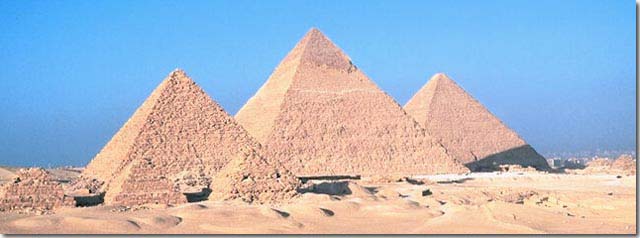
The only one of the Seven Wonders of the Ancient World still standing,
the Pyramids of Giza are a sight that dwarfs even the greatest modern
buildings. The size, age and perfection of this complex makes it one
of the most awesome achievments in all of human history.
|
|
 |
Actually only one of the pyramids - the Great
Pyramid of Khufu - was classified in the 5th century BC as a "Wonder".
It is the oldest of the three major and many minor pyramids here.
Its stupendous size, great antiquity and unbelievable mathematical
perfection make it not just a wonder but a downright mystery. How
it was built is still not known. Ingenious
tunnels within are still being explored and discovered.
There are two other pyramids in the complex - Khafre and Menkaure.
These, while also very impressive, are easily overwhelmed by the sheer
scope of their bigger cousin. But together they form a truly majestic
spectacle.
|
|
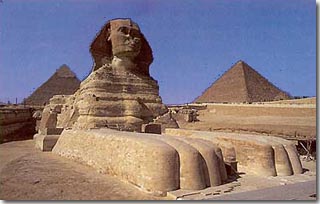
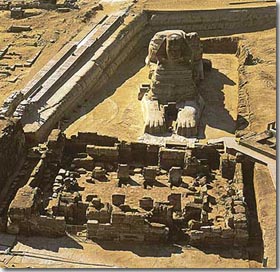
The Giza Plateau also home
to the Great Sphinx, perhaps the best known
monument in the whole of Egypt.
The Pyramids, Sphinx and adjacent temples make up the Necropolis
of Memphis, primarily built during the 4th Dynasty (2575-2467 BC). |
 |
|
At around 2575 BC Pharaoh Khufu (aka. Cheops) makes his mark on the
landscape. For him the greatest and most famous pyramid of all was
constructed, the Great Pyramid of Giza. When looking at the pyramid
group on the Giza plateau it does not seem to be the largest. This
is because the tallest looking one has been built on higher ground,
but is 10 metres smaller.
To build the Pyramid of Khufu, some Egyptologists speculate that
84,000 people employed for 80 days a year worked for 20 years to complete
it. Incredibly, for over 40 centuries it was the tallest man-made
structure on earth, only surpassed with the advent of the 19th century
and high-tech steel construction techniques.
|
|
| |
|
|
|
|
|
|