Domain Eukaryota
Rhodophyta - Red Algae |
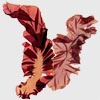 |
The Rhodophyta or Red Algae are a large
and diverse group of mulitcellular marine algae.
Many are notable and beautiful algae. The 4,000+ species continue to
elude classification.
|
The Rhodophyta, like other Archaeplasdida, all have photosynthesizing
chloroplasts wrapped in double membranes (inherited from an anciently
absorbed cyanobacteria). They have chlorophyll a, but unlike
Land Plants, lack b. They have the piment phycobilin,
which give the Rhodophyta their reddish color (and allows them to absorb
light at greater water depths).
|
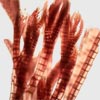
| Most Rhodophyta have multicellular
forms but lack cellular differentiation - the 'division of labor' into
tissues and organs. Instead they have a thallus, a body without
true roots, stems or leaves. |
 |
Most are immobile, attached to surfaces or to other algae. Unlike other
algae, the Red Algae have no flagella at any point.
They have a complex three-part life cycle using cellular division,
eggs and sperm, and/or spores. Their reproductive cells (gametes)
can't move, but they manage to proliferate nonetheless.
Like the Land Plants, the Rhodophyta have cellulose in their cell walls.
They also have stcky polysaccharide starches, which make them
economically valuable as thickening agents for many foods and industrial
products.
|
 |
The Rhodophyta take many forms - tiny and delicate;
spreading filaments, wavy sheets; large and 'fleshy', or covered in coral-like
carbonate shells. Classification schemes face regular modification and
many species remain undescribed. |
Genetic studies continue. The following are currently tentative groups:
- The Florideophytes are a large, widespread group. They
grow only from the tips of the branching thallus. The simple chloroplasts
are disc-shaped.
- The Bangiales have thalli with soft, thin filaments spreading
in dense layers.
- The Porphyridiales are widespread and grow in papery-thin
sheets along shorelines. They have a slippery texture and resists
dryness well. Often used for food (nori, kim)
- The Compsopogonales have branching filaments and found
in freshwater streams. Possibly related to:
- The Batrachospermum, with tangled, beaded; gelatinous filaments.
Found in freshwater streams.
- The Cyanidiophytes are blue-green, unicellular and form
aggragated mats. Branched off early from kingdom.
- The Rhodellophyceae are single-celled and like brackish
waters..
- The Corallinales are coral-like. They have a dense thallus
and form a calcium carbonate skeleton.
- The Gigartinales have large thalli and fleshy, brownish-red
fronds. Source of carageenan, a common food additive.
|
| (close
window) |
|
|
|