Domain Eukaryota
Cercozoa |
 |
The Cercozoa are a large group of amoeboid
and flagellate Rhizaria.
Though diverse and difficult to describe by structural similarities,
genetic studies confirm the unity of this kingdom. |
The Cercozoa all engulf their
food with filament-supported psuedopodia (filopodia). They
never have a cytostome (mouth). The main groups include:
- The Cercomonadida (above) use filopodia for feeding
and have two flagella, but move by gliding along surfaces. Complex
reproduction. Common in soil and water.
|
- The Silicofilosea (or Euglyphids) (right)
assemble silica plates into a shell with a single opening for the
filopodia. Common in soil and marshes.
|
 |
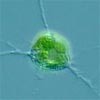 |
- The Chlorarachniophyta (left) are strange amoebids
that link together in multicellular nets. They have chloroplasts bound
by four membranes and a vestigal nucleus (all leftovers from an anciently
consumed green alga).
|
- The Nucleohelea have spherical cells attached to stalks and unusual
nuclei fibers.
- The Phaeodarea are marine amoebids that produce porous shells made
of silica and organic waste clusters.
- The Phytomyxea are parasites of agricultural plants. They have a
flagellated stage. Their nuclei make a cross-shape when replicating.
- The Thecofilosea have organic shells. Their classification is uncertain.
Many of these Cercozoan groups were formerly classified with other
groups including the Radiolaria, Amoebozoa or Fungi. But genetic research
has brought them together into this kingdom.
The unusual structure of shells and organelles in the Cercozoa make
them of great interest to researchers studying the endosymbiotic origins
of the Eukaryotes.
|
| (close
window) |
|
|
|
|