
Setting Up Your Saltwater Aquarium
|
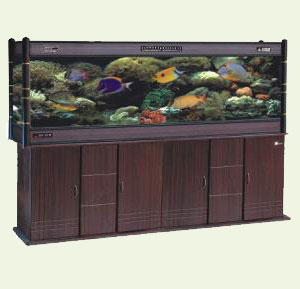
Tank Size
Tank size does matter. Even though you may have found a small fish, it needs room to grow and to roam about. A clownfish can be happy in a 10 gallon tank, but a 20 or 29 gallon tank will allow you to add more creatures in the future, giving you a beautiful piece of the ocean in your home. Tangs are herbivores, and need a lot of room to swim. Bare minimum for this fish, when a juvenile, is a 55 gallon aquarium. Some need a 75 gallon, or even a 125 gallon! Tangs love to swim long distances quickly, and to put them in a smaller environment will cause them stress and they can die from stress-related illnesses (such as “Ich”).
Handling Your Equipment
Make sure your hands and your equipment are clean. Never put your hands in your tank if they have soap or hand lotion on them. Never clean any equipment with soap. Buy a new sponge that does not have “anti-mildew” additives, and keep it with your saltwater stuff, where it never will be used with soap accidentally. You can often times clean things with a mixture of common white vinegar and hot water, to remove calcium deposits.
Heater
Your tank needs to have a stable temperature. 76° F to 84° F is your allowable tolerance. Keeping it between 78-82° F is the ideal. A small reliable heater will keep the tank from cooling too much at night (especially this winter). A small fan blowing across the top of your tank will avoid overheating during the summer months.
Lighting
Most tanks come with a single “Normal Output” fluorescent bulb, which is sufficient for fish. If you desire greater variety of items, such as corals or anemones, you’ll need far more lighting to allow them to thrive, let alone survive. When you get to that point, then your options will be VHO (Very High Output), PC (Power Compacts), or MH (Metal Halide). These will be very costly, but your inhabitants will respond with healthy growth. These lights are not necessary for tanks with a few fish, however. Buy a simple 24 hour timer to plug in your lights, so they run about 10-12 hours a day.
Type of Water
To avoid nuisance algaes growing in your tank, it is recommended to get Reverse Osmosis De-Ionized water. You can often times buy this kind of water at the fish store where you found your saltwater pet. You can also buy RO water at your supermarket, as well as distilled water. What you don’t want to use is tap water from the sink. It contains elements that are detrimental to your saltwater tank. Chlorine, Phosphate, Nitrate, Fluoride and more are readily detectable in tap water, but your saltwater tank needs pure water to keep your fish healthy.
Salt
Marine salt is readily available at most pet supplies, and Instant Ocean is very popular and easy to find. When you are setting up your tank, or when you do water changes, you always mix the salt in your water before you add it to your tank. You’ll need a hydrometer, which gives you a “salinity reading” to mix the salt to the correct level. To gauge your mixing, use ½ cup of salt per gallon of water, but test it with the hydrometer. You want your salt level at 1.026 sg (specific gravity), and your water’s temperature at that reading should be 78 degrees. As water evaporates from your tank, you only need to add new RO or distilled water, because only water is evaporating from your tank. The salt is still there. Adding saltwater would only increase the salinity of your tank and cause problems for your fish.
Cycling the Tank
Unlike a freshwater tank, it takes time for a saltwater tank to be ready for a new fish or other creature. Once your tank has been set up, you’ve added your sand, filled it with saltwater, turned on the heater, started the filters, now you can add your live rock. What your tank needs is bacteria, and you need to breed it before your new pets are added. A very easy way to do this is to buy one or two uncooked cocktail shrimp from the deli at the supermarket. Just throw them in the tank and let them rot. As they do, bacteria will grow as a result. Ammonia levels will rise in the tank over the period of a week or 10 days, then it will suddenly drop (you’ll observe this with your Ammonia test kit), and Nitrites will rise quickly over a period of another few days. Finally, the Nitrites will drop off completely (reading 0 with your Nitrites test), and Nitrates will begin to register on your Nitrates test kit. As soon as your Ammonia and Nitrites tests both read 0 on the matching test kits, it is safe to add the new fish.
Circulation
Using a few power heads in your tank will move water throughout the tank. If you can avoid “dead” zones in your tank, nuisance algae will be less likely to grow. Cyanobacteria, for example, grows in areas that are stagnant. Pointing the output of a powerhead toward the surface of your tank to cause the water to ripple will help with gas exchange. This means oxygen will get into the water, and carbon dioxide will get out. This also keeps your surface nice and clean, and avoids stagnant or oil-like scum from accumulating on the surface of your water.
Water Tests
Most important of all, saltwater tanks must be tested weekly to make sure your water is healthy so your fish will remain healthy. For a simple fish only tank, you’ll want to test pH, Ammonia, Nitrite, and Nitrate. Your pH should test around 8.0 to 8.3. Ammonia should read 0 before adding any fish, and so should your Nitrite. Nitrate should be 20 ppm or less, and the best way to keep these down is regular water changes. Another important test is Alkalinity, which tests your water hardness. This should be between 8 and 11 dKH. Also, be sure to double check your salinity weekly to make sure it has remained stable at 1.026ppm.
Protein Skimming
This is a fail-safe way of keeping your water clean and pure. There are many types of protein skimmers on the market, and some are great and some are worthless. The two highly regarded ones are made by Aqua C and EuroReef. For a small aquarium, the Aqua C Remora will do a good job of pulling out waste before it can decay into ammonia and nitrites, which are both toxic to your fish. For a larger tank, like a 55 gallon for a Tang, you could get the Aqua C Remora Pro. What the skimmer does is inject air into a column of water in the unit, which creates tiny micro bubbles that carry Disolved Organic Compounds (DOCS) out of your tank and into a collection cup that you can pour out and rinse quite easily. An added benefit of this device is it adds oxygen to your tank. Unlike a freshwater tank, saltwater tanks don’t need an airstone pumping bubbles into your tank. A good skimmer will cost you between $150 and $200.
Adding the Fish
As you add fish to your tank, you increase the biological load in your tank. It can only accept so much at one time, so it is far better to add new things very slowly to your tank, rather than all at once. That way the beneficial bacteria in your tank can increase to handle the new load and not create a sudden Ammonia spike in your tank. By adding things slowly, the tank, the water, and the natural filtration will adjust for the new load. Remember, a new pet will require you to feed a little more, and that fish will add waste for your tank to absorb, so you need your natural filtration to keep up.
"Janitors"
Adding a few snails and small hermit crabs will help keep your tank clean. The snails will eat algae that grows on the glass or rocks, as well as the hermits. They also will consume excess food and waste the accumulates in your tank, helping keep things clean. You can not add these janitors until your tank has fully cycled. If you see a snail that is upside down on the floor (or substrate) of your tank, take the time to flip it back over, or a hermit crab will eat it and take the shell as its new home.